


That shift reflects something important: the UAE business landscape has grown sophisticated enough to learn from the first wave of digital investment mistakes. Companies that rushed into app development without product strategy, that launched websites without UX foundations, that built internal SaaS systems around the wrong workflows — they exist as cautionary case studies now. And the market has responded by raising its standards. The businesses succeeding in digital product development in 2025 are doing it differently from those that burned money on it five years ago.
This guide walks through what that looks like in practice — from the strategic decisions made before a single line of code is written to the infrastructure choices that determine whether a product can scale when it needs to.
Why UAE Businesses Fail at Digital Products (And It’s Not What You Think)
The most common autopsy finding on failed digital products in the UAE is not technical. It’s not poor development quality, not wrong technology stack, not underpowered servers. The failure almost always traces back to decisions — or the absence of decisions — made before development began.
Specifically, it traces back to skipping the question that should precede every digital product: what problem are we actually solving, and for whom, and how do we know that’s the right problem?
This sounds obvious. In practice, it gets bypassed constantly, because business stakeholders are often more comfortable with deliverables than with questions. A wireframe is tangible. A prototype feels like progress. A finished app has visible dimensions that can be presented in a board meeting. The research and strategy work that should precede these deliverables produces documents that don’t look like finished things, even when they contain the insights that determine whether the finished things will work.
The result is products built with confidence in their execution and uncertainty about their premise. They launch to silence. Not negative reaction — silence is more common and harder to diagnose. Users try them once and don’t return. The business can’t identify what’s wrong because it never clearly defined what right would look like.
In the UAE specifically, there are additional dimensions to this challenge. The market is genuinely multicultural — a large proportion of UAE residents are expatriates from dozens of different countries, with different digital behavior patterns, different expectations for interfaces, and different comfort levels with various types of digital interaction. A product designed with one user population in mind often fails with another, and in the UAE, your product typically has to serve multiple simultaneously. This requires research specificity that goes well beyond “we know our market.”
The UAE also operates within a regulatory and business environment that affects digital products in ways that teams importing frameworks from Europe or the US don’t always anticipate. Data residency requirements, payment processing specifics, the Arabic language interface obligations for certain product categories, and the expectations of government digital integration all shape what a viable digital product looks like here in ways that require local knowledge rather than generic approaches.
Strategy Before Pixels: What Good Product Strategy Actually Involves
The word strategy gets applied loosely in digital product contexts, covering everything from “we want to build a mobile app” to genuinely rigorous work that examines market positioning, user research, technical feasibility, and business model alignment simultaneously. Understanding what substantive product strategy involves helps businesses evaluate whether what they’re being sold is real or cosmetic.
Genuine product strategy starts with a market problem definition that’s sharper than “there’s an opportunity in X space.” It identifies a specific friction point, a specific user population experiencing it, the current workarounds they’re using (which tells you a great deal about what the solution needs to provide and how high the switching cost is), and an assessment of why existing solutions don’t adequately address it. This analysis shapes every subsequent decision.
Competitive landscape mapping in the UAE context requires attention to both global and regional players. Many UAE businesses make the mistake of benchmarking only against international incumbents, missing the regional competitors who understand local nuance better and the regional expectations that global products don’t fully serve. The insight here is usually not “let’s beat the global platform” but “let’s serve the aspects of this market that the global platform consistently underserves.”
Business model alignment is where strategy connects to sustainability. A digital product that works phenomenally well from a user experience perspective but doesn’t generate sustainable revenue — or that generates revenue in a way that conflicts with user trust — will eventually fail regardless of its quality. Working out the monetization model before design begins shapes the product’s information architecture, its onboarding flow, its retention mechanics, and dozens of other decisions that are expensive to reverse once built.
UX Design for UAE Digital Products: Beyond Aesthetics
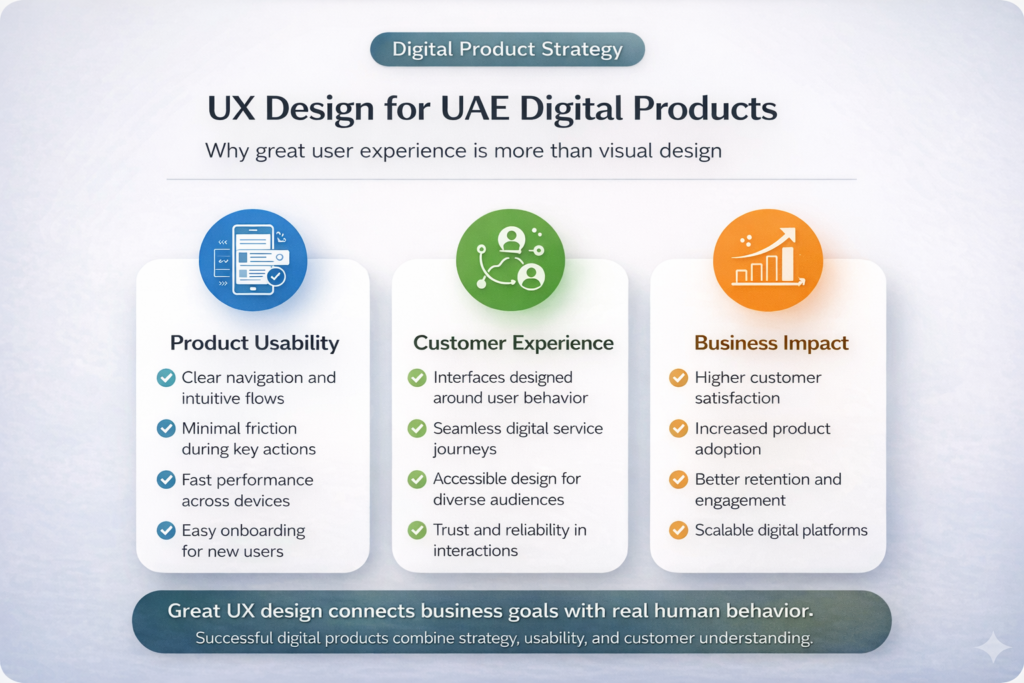
User experience design gets misunderstood in two directions simultaneously. On one side, it gets reduced to visual design — colors, typography, icon style, the aesthetic surface of a product. On the other, it gets inflated into an abstract philosophy that has no practical grounding. Neither characterization captures what UX actually produces or why it matters so much in the UAE context.
UX is fundamentally the architecture of how a user moves through a product to accomplish what they came to do. It’s the sequence of screens, the information hierarchy, the decision points, the labels, the feedback mechanisms, the error states. Done well, it makes the right action obvious at every step without requiring the user to hold context in their head or figure out what to do next. Done poorly, it creates friction that accumulates until the user gives up — and in a market where mobile app abandonment is high and user attention is limited, friction is fatal.
In the UAE specifically, UX has dimensions that templates borrowed from the US or European markets don’t adequately address. The bilingual Arabic-English requirement for many products isn’t simply a translation exercise. Arabic is right-to-left, which means the entire interface layout logic needs to mirror — not just the text. Navigation patterns, iconography placement, visual hierarchy, and reading flow all invert. Producing a genuinely good Arabic language experience requires designers who understand how Arabic-speaking users read digital interfaces, not designers who applied a text swap to an English layout.
Cultural context shapes interaction expectations in subtler ways too. Trust signals that work in one cultural context don’t necessarily transfer. Social proof mechanisms, privacy communication, and the framing of financial interactions all carry different valences in different cultural backgrounds. For a UAE product serving a multicultural user base, this analysis has to be done at the research phase — before the design phase — because the findings should shape the design rather than being patched onto it afterward.
Accessibility is an increasingly significant consideration in UAE digital products as government and enterprise clients apply more rigorous procurement standards. Products that meet international accessibility guidelines (WCAG 2.1) reach broader user populations and satisfy compliance requirements that are becoming standard expectations in the regional market.
Web vs Mobile vs SaaS: Choosing the Right Product Form Factor
One of the more consequential decisions in digital product development is the choice of form factor — and it’s one where businesses often default to preference or trend rather than doing the analysis that would produce the right answer.
The question isn’t “should we build an app or a website?” It’s “where do our target users interact with this type of product, what tasks are they trying to accomplish, and what form factor supports those tasks most naturally?” The answer follows from the analysis.
Mobile apps make the most sense when the core use case is contextual and frequent — something users do on the move, regularly, where the phone’s native capabilities (camera, GPS, push notifications, biometric authentication) add genuine value. Ride-hailing, fitness tracking, food delivery, bank account management — these products earn their place on a device’s home screen because they’re used often enough to justify installation and the core functionality is genuinely enhanced by native integration.
Web applications make more sense when the primary use cases involve longer sessions, more complex data input, multi-window workflows, or integration with other software systems. B2B SaaS products, internal tools, analytics platforms, and e-commerce management systems typically live more naturally on web than on mobile, even if they also have companion mobile interfaces for specific tasks.
SaaS as a business model — subscription access to software delivered over the internet — is distinct from these form factor questions, though it interacts with them. The UAE market has developed strong familiarity with SaaS subscriptions in recent years, both among businesses (HR software, accounting, CRM) and increasingly among consumers (productivity tools, creative applications). Building a product as SaaS rather than a one-time purchase changes the economics, the development priorities, and the retention mechanics in ways that need to inform the product strategy from the beginning.
AI-integrated products occupy their own category now. The meaningful question is not “should we add AI?” but “where does genuine AI capability solve a real user problem that isn’t solved by conventional logic?” Products that integrate AI where it makes a meaningful difference to outcomes — intelligent document processing, natural language query interfaces for complex data, predictive recommendations built on real behavioral data — are producing genuine user value. Products that add AI features to justify a market positioning are producing noise. Distinguishing between the two requires the kind of honest problem-first analysis that good product strategy demands.
The Development Phase: What Forward-Thinking UAE Businesses Are Getting Right
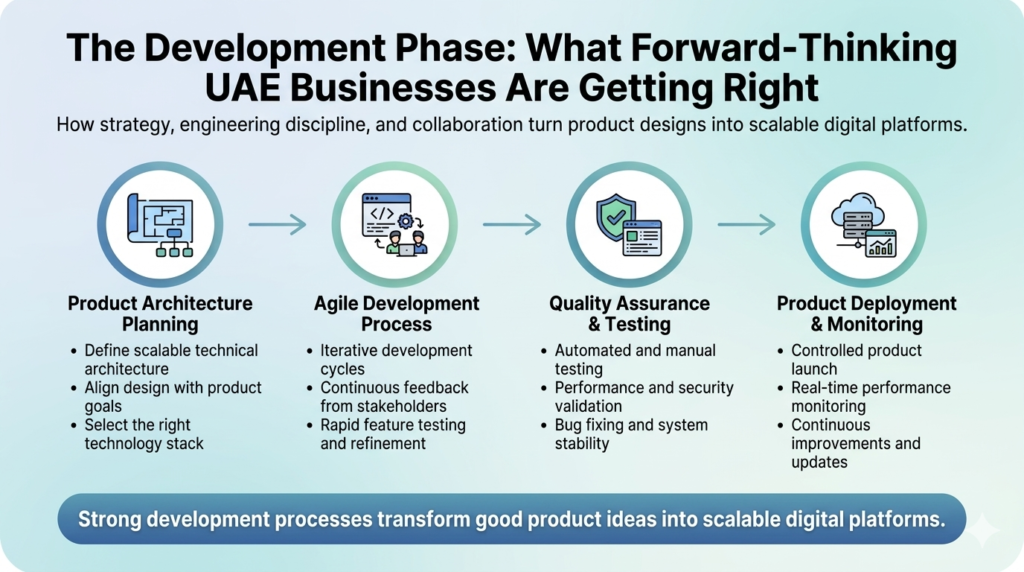
The gap between a finished design and a functioning product is where many digital product projects lose momentum, quality, or both. Understanding what effective development looks like — and what warning signs indicate a project is going off the rails — is useful for business stakeholders who aren’t engineers but are accountable for outcomes.
Effective development for digital products in 2025 follows an iterative delivery model: working software delivered in short cycles, each cycle producing something testable and reviewable by actual users or business stakeholders. This isn’t a stylistic preference — it’s the mechanism by which feedback gets incorporated before the consequences of wrong decisions compound through the entire product architecture. A wrong assumption caught in week four is a much smaller problem than the same wrong assumption discovered after six months of building on top of it.
Technical architecture decisions made early — choice of technology stack, data model design, API structure, authentication approach — have long tails. Products that choose technologies appropriate to their scale and likely growth trajectory are easier to maintain and extend. Products that choose technologies because they’re fashionable, or because a specific developer prefers them, accumulate technical debt that becomes visible as limitation over time.
Quality assurance is where many projects underinvest, particularly in the UAE market where development timelines are often compressed by client urgency. The consequence is products that launch with bugs that damage user trust, security vulnerabilities that create liability, and performance issues that show up under real-world load conditions that testing didn’t replicate. Treating QA as an integral part of development rather than a final phase to be shortened under schedule pressure is a practice that distinguishes mature development operations from less experienced ones.
Infrastructure That Matches Product Ambition
A digital product can be excellently designed, carefully researched, and well-built — and still fail in practice because the infrastructure it runs on doesn’t support the performance and reliability that users expect.
For product teams and founders in the UAE, infrastructure decisions involve considerations that don’t apply uniformly elsewhere. Data residency — the requirement or strong preference for user data to remain within UAE or GCC jurisdiction — is increasingly significant for enterprise and government clients, and it shapes hosting decisions in ways that simply adopting the nearest AWS region doesn’t always address.
Performance expectations in the UAE market are high, partly because the population is mobile-first and has strong expectations about load speed, and partly because the competitive landscape includes products backed by major regional players with substantial infrastructure investment. A product that loads slowly relative to its competitors creates a quality perception gap that content and features alone can’t close.
For startups and growing product teams that need hosting infrastructure managed alongside on-demand development support — without the overhead of building a full in-house DevOps capability —technical co-founder-style support covering hosting, server management, security, and development fixes on a subscription basis, letting founders stay focused on product and growth rather than firefighting infrastructure problems.
Security is non-negotiable at any scale. SSL certificates, regular backups, malware protection, DDoS mitigation, and secure authentication implementations aren’t features to add later — they’re baseline expectations for any product handling user data, and they become compliance requirements when enterprise or government clients are involved.
Growth, Iteration, and the Product Lifecycle in UAE Context
A digital product at launch is not the product it will be eighteen months later. The businesses that build digital products with long-term growth in mind approach launch as a hypothesis test rather than a finished statement. They define the metrics that will tell them whether their core assumptions were right — user activation rate, retention at 30 days, session frequency, conversion on the core action — and they build the instrumentation to measure them before launch, not after.
The iteration that follows initial launch is where the best UAE digital products earn their quality. Each release cycle is informed by a combination of quantitative behavioral data (what users actually do, measured) and qualitative research (what users say and why). These inputs together produce a picture that neither provides alone — behavior data tells you what’s happening, qualitative research tells you why.
The UAE digital market moves quickly enough that products that don’t iterate fall behind. Features that were innovative eighteen months ago have been adopted by competitors or superseded by platform-level capabilities. Businesses that build an iteration rhythm into their product operation — regular release cycles, regular user research, regular performance review — maintain the relevance that periodic major relaunches try but frequently fail to achieve.
Growth in the digital product context also involves distribution — how new users find the product and what converts them. For B2B SaaS in the UAE, this increasingly involves content strategy built around the problems the product solves (which generates organic search visibility and inbound interest), alongside sales-assisted acquisition for enterprise accounts. For consumer products, it involves understanding the specific mobile and social channels where the target user population is reachable and the creative and messaging approaches that earn attention in those channels.
What Separates Good Digital Products From Great Ones in the UAE
The UAE has no shortage of digital products. Apps, platforms, portals, and tools multiply across every vertical. What’s rarer — and what commands genuine loyalty, generates word-of-mouth, and holds market position over time — is products that feel considered rather than assembled.
Considered products are those where every decision traces back to a clear understanding of what the user needs and what the business needs to sustain itself. Where the interface makes the right action obvious without instruction. Where the edge cases have been thought through. Where the performance under load has been tested. Where the Arabic and English versions are genuinely equivalent rather than one being a translation of the other. Where the onboarding converts effectively because it was designed around how real users approach the product, not how the product team imagines they do.
These qualities come from process, not talent alone. The most skilled design and engineering teams produce mediocre products when working from inadequate strategy. The same teams working from clear problem definitions, validated user research, and honest business model analysis produce products that consistently outperform their category.
That process — strategy through execution through growth — is what the UAE’s most capable digital product studios are selling. Not software, not design files, not code repositories. A way of building that makes good outcomes consistently reproducible. In a market moving as fast as the UAE’s, that consistency is the real competitive advantage.